Why CA-45's Housing Crisis Is a Policy Problem, Not a Market Problem
May 8, 20264 min
If you live in Fountain Valley, you know the frustration of opening your monthly cable and internet bill. Rates climb relentlessly past $80 to $110 a month for sluggish, asymmetrical connections that buffer during work calls and choke on evening streaming. When service drops, you are left waiting on hold with a monopoly provider that knows you have nowhere else to turn.
This isn't an accident. It is the direct consequence of a failed telecommunications model that treats high-speed connectivity as a private corporate fiefdom rather than essential municipal infrastructure.
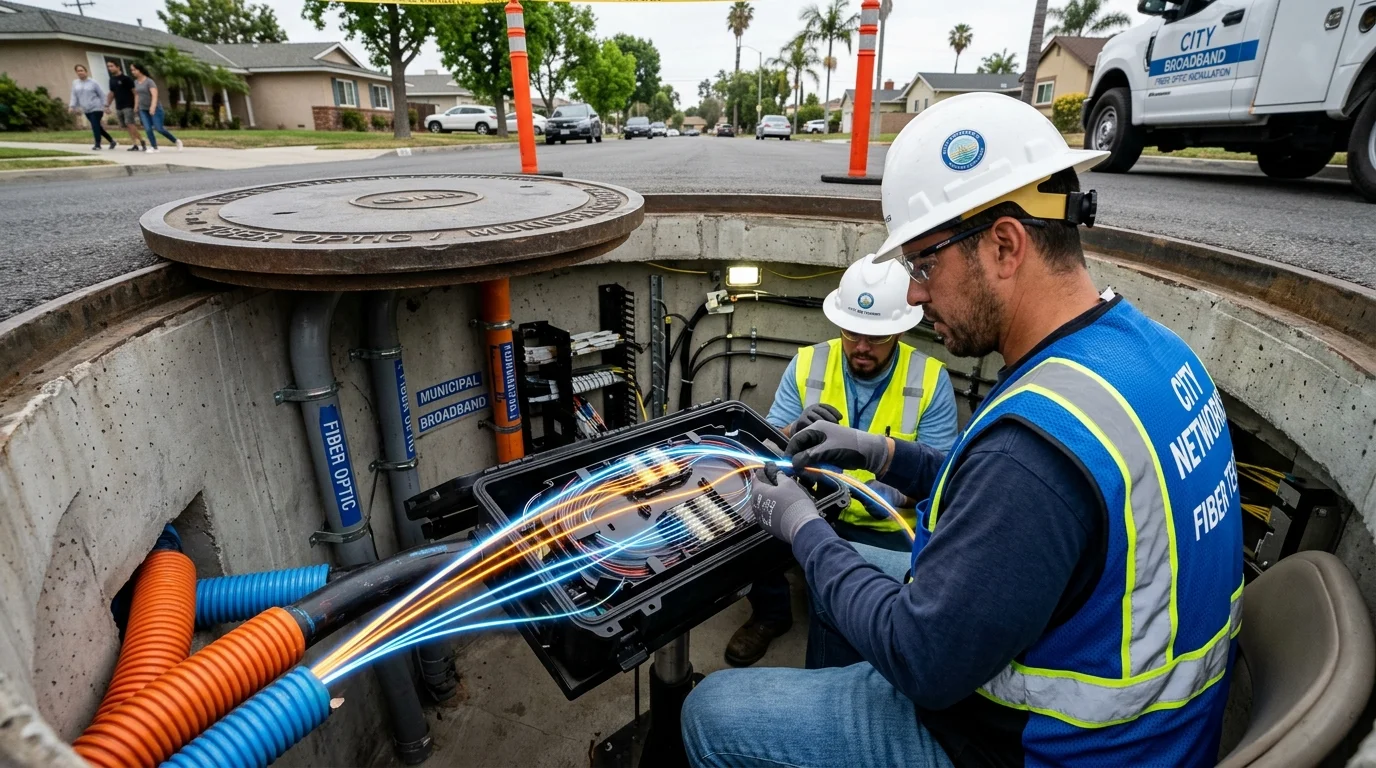
Fountain Valley is a mature, fully built-out city of roughly 9 square miles. Our residential neighborhoods, small businesses along Brookhurst and Magnolia, and multi-family apartment communities deserve world-class digital infrastructure. The good news is that we don't need to raise a single dollar in taxes or create a bloated government agency to get it. By implementing an Open-Access Public-Private Partnership (P3), we can deliver symmetrical 1 to 10 Gbps fiber across the entire city while cutting monthly bills nearly in half.
Legacy cable and telecom operators operate on cherry-picked economics. When deploying fiber upgrades, private monopolies prioritize low-density single-family neighborhoods where trenching front yards is simple. Dense multi-dwelling units (apartments, condominiums) and small business strip corridors are routinely skipped due to complex riser access agreements and short-term corporate profit calculations.
This creates an artificial digital divide in our own city. Working families in multi-family housing and independent shop owners on Slater and Talbert are locked into outdated copper and coaxial lines, paying premium monopoly rates for second-rate reliability.
As Fountain Valley plans for inward growth through Housing Opportunity Overlays (HO1/HO2) along underutilized commercial corridors, top-tier symmetrical fiber is vital to attract responsible private investment, support remote workers, and empower local entrepreneurs.
Rather than operating a government-run internet provider or waiting for cable monopolies to do the right thing, the city can adopt a proven Open-Access Public-Private Partnership (P3).
Under this model:
When ISPs are forced to compete for your business on an open network, prices plunge. Gigabit symmetrical service typically drops to $55 to $70 per month with no data caps, no hidden equipment fees, and transparent pricing.
This is not theoretical. Just north of us in Orange County, the City of Placentia (population ~51,000 across 6.6 square miles) executed this exact model.
Through a $35 million privately funded open-access deployment, Placentia connected over 20,000 residential and commercial parcels with zero taxpayer dollars risked. The introduction of competing retail ISPs immediately forced incumbent providers like Spectrum and AT&T to lower their rates regionally. Even more importantly, Placentia saw sustained net-positive business license growth in flex-office, light industrial, and medical-technology sectors because modern enterprises need reliable gigabit bandwidth.
If elected to Fountain Valley City Council, I will immediately champion three concrete policy reforms to bring open-access fiber to our city:
High-speed internet is no longer a luxury. It is foundational to household budgets, student education, and small business success. Fountain Valley has the density and location to lead Orange County in digital infrastructure. All it takes is the political will to break the monopoly stranglehold and put residents first.
Mark Leonard is running for Fountain Valley City Council. This article is part of his campaign to bring fiscal transparency and community-first solutions to our city.
Share your thoughts on this issue. We're building a campaign grounded in the real concerns of Fountain Valley families and residents.